How to Choose the Best Lead Acid Batteries for Your Needs?
Choosing the right Lead Acid Batteries is critical for numerous applications. In the evolving landscape of renewable energy, the demand for efficient batteries continues to rise. According to a report by GlobalData, the Lead Acid Battery market is expected to reach $85 billion by 2027. This growth reflects the increasing reliance on these batteries for solar energy storage, automotive applications, and more.
Expert insights underline the importance of selection. Dr. Emily Chang, a leading researcher at the International Battery Association, states, "Choosing the right type of Lead Acid Battery significantly impacts performance and longevity." Factors such as capacity, cycle life, and charging time are crucial. Potential buyers often overlook these aspects, leading to underperformance and regrets after the purchase.
Navigating choices can be overwhelming. Not all batteries are created equal. There may be a tendency to go for the cheapest option, which might compromise quality. Understanding specifications and matching them to your requirements is essential. Reflecting on these elements can lead to more informed decisions, ultimately enhancing your experience with Lead Acid Batteries.

Understanding Lead Acid Battery Types and Their Applications
When selecting lead acid batteries, understanding their types is crucial. There are two main categories: flooded and sealed. Flooded batteries require maintenance, such as regular watering. However, they often deliver more power in short bursts.
On the other hand, sealed batteries, such as AGM and gel types, offer convenience. They are maintenance-free and ideal for tight spaces.
Applications vary across industries. For instance, flooded batteries are common in solar energy systems. They are reliable for long-term energy storage.
Sealed batteries find a place in mobility. They're often used in UPS systems and marine applications. Choosing the right type depends on the specific demands of your projects.
It’s essential to consider the trade-offs. Flooded batteries can be less expensive, but their maintenance may deter users.
Meanwhile, sealed batteries boast easier installation but may come at a higher cost. Reflecting on your needs can help you make an informed decision.
Consider the environment where the battery will be used, and the expected lifespan. When in doubt, consult with a battery expert to ensure your choice aligns with your requirements.
Key Factors to Consider When Selecting a Lead Acid Battery
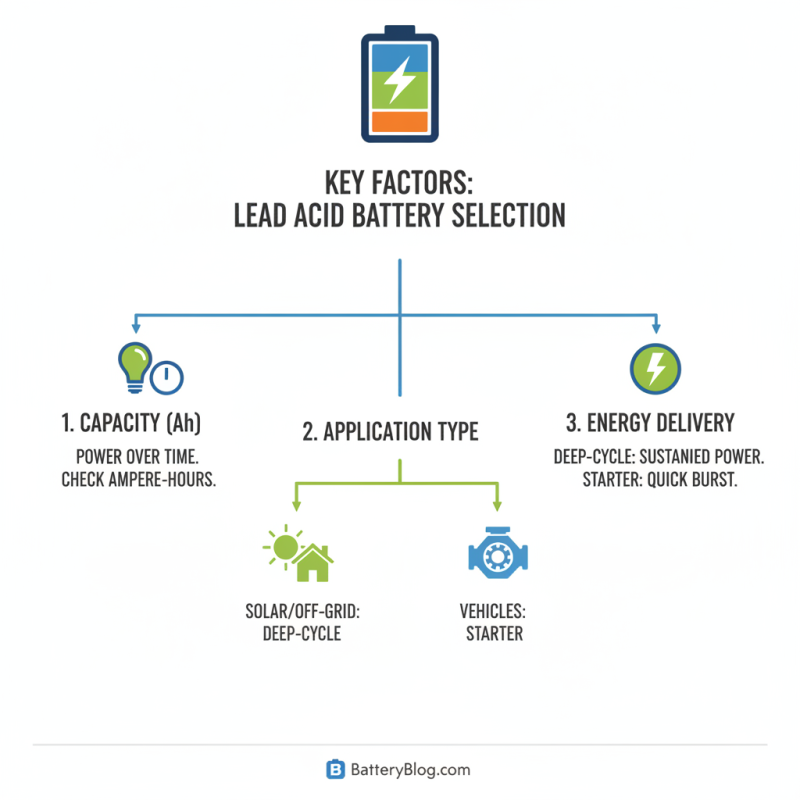
When choosing a lead acid battery, consider the capacity you need. Think about the application. A deep cycle battery serves well for solar setups. For vehicles, a starter battery offers quick bursts of energy. Capacity is measured in ampere-hours (Ah), so check that number closely.
Voltage is another critical aspect. Most lead acid batteries come in 6V or 12V options. Ensure compatibility with your system. A mismatch might lead to poor performance or even damage. It’s easy to overlook this detail. Take your time to confirm voltage specifications.
Durability plays a significant role. Check the design and build of the battery. Some models feature robust casings designed to withstand harsh environments. If you operate in extreme temperatures, this aspect is crucial. Also, consider the battery's lifespan. A longer lifespan means fewer replacements, but it may come at a higher upfront cost. Weigh your budget against long-term needs carefully.
Evaluating Battery Performance Metrics for Your Requirements
When evaluating lead acid batteries, performance metrics are essential. These metrics include capacity, discharge rates, and cycle life. Capacity measures how much energy the battery can store, typically expressed in amp-hours (Ah). A higher capacity means longer usage time for devices powered by the battery.
Discharge rates are another vital factor. They indicate how quickly a battery can release its stored energy. This is crucial for applications requiring immediate large power bursts. A battery with a high discharge rate can effectively manage high-demand situations. However, not all batteries perform well under stress. Some may exhibit reduced cycle life when frequently discharged quickly.
Cycle life reflects longevity and reliability. It shows how many complete charge and discharge cycles a battery can undergo before significant capacity loss occurs. Reports show that lead acid batteries typically last between 300 and 1,000 cycles, depending on usage and maintenance. This range can vary greatly. Some users may experience lower cycle life due to poor charging practices. Evaluating these performance metrics will empower users to choose the right battery for their specific needs.
How to Choose the Best Lead Acid Batteries for Your Needs? - Evaluating Battery Performance Metrics for Your Requirements
| Battery Type |
Capacity (Ah) |
Voltage (V) |
Cycle Life (Cycles) |
Weight (kg) |
Price (USD) |
| Flooded Lead Acid |
100 |
12 |
300 |
28 |
150 |
| AGM Lead Acid |
120 |
12 |
450 |
32 |
200 |
| Gel Lead Acid |
105 |
12 |
600 |
30 |
220 |
| SLA Lead Acid |
75 |
12 |
250 |
20 |
100 |
| Lithium-ion Hybrid |
150 |
12 |
700 |
35 |
350 |
Comparing Battery Pricing and Lifespan for Cost-Effectiveness
When selecting lead-acid batteries, pricing and lifespan play vital roles in overall cost-effectiveness. According to the International Energy Agency, the typical lifespan of lead-acid batteries ranges from 3 to 5 years, depending on usage and maintenance. Meanwhile, unit prices can vary significantly. A low-capacity battery might cost around $100, while a high-capacity alternative may exceed $300.
It's essential to assess your needs before making a decision. For instance, frequent deep discharges can shorten battery life. A study by the Battery University indicated that discharging below 50% may reduce lifespan by up to 30%. Additionally, consider installation costs, which can add anywhere from 20% to 50% to your initial expenditure.
The price-to-lifespan ratio must be carefully evaluated. Sometimes, a higher upfront cost can lead to better long-term savings. Evaluating how much energy storage you require will shape your battery choice. Not every option meets every need perfectly. Reflect on your usage patterns, as they significantly influence performance and value over time.
Maintenance and Care Tips for Prolonging Battery Life
Maintaining lead-acid batteries is crucial for longevity. Regularly check the electrolyte levels, ensuring they are neither too low nor too high. This balance helps prevent sulfation, which can shorten battery life. If possible, use distilled water to refill. Keeping terminals clean is another key point. Corrosion can hinder performance, so a simple wipe with a mixture of baking soda and water can work wonders.
Routine charging is vital to keeping your battery in top condition. Avoid deep discharges, as this can reduce capacity. Instead, aim to keep the battery charged between 40% and 80%. If you notice the battery frequently dips below this range, reevaluating your usage may be necessary. Proper storage is also important; store batteries in a cool, dry place when not in use. Temperature extremes can damage internal components.
Pay attention to the age of your battery. Lead-acid batteries have a finite lifespan, typically lasting 3 to 5 years. Regular check-ups can help identify weakening performance. If the battery shows signs of wear or decreased capacity, it's time to consider replacement. Reflecting on your habits with battery use can also lead to better maintenance practices.