
Mobile Lighting Trailer Supplier
The Intelligent Development Trend of Solar Mobile Lighting Trailers
The Intelligent Development Trend of Solar Mobile Lighting Trailers
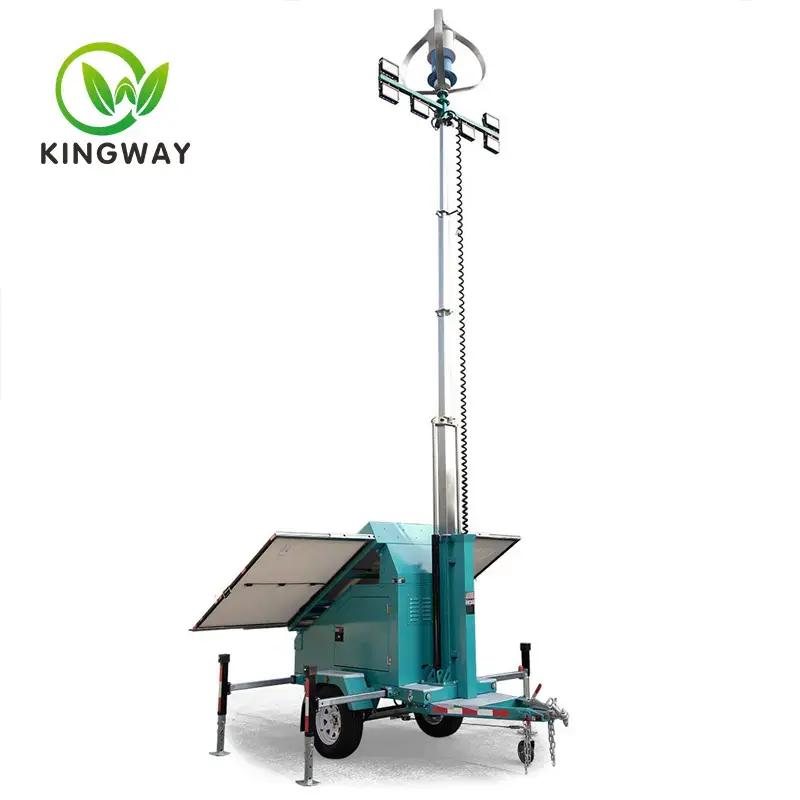
Driven by the dual global "dual carbon" goals and digital transformation, solar mobile lighting trailers are evolving from traditional "portable lighting tools" to "smart energy service terminals." As core equipment for outdoor temporary lighting and emergency support, their intelligent evolution not only meets the demand for efficiency in scenarios such as infrastructure construction, emergency rescue, and large-scale events, but also reshapes the technological landscape and market structure of global lighting equipment. According to industry reports, the global mobile lighting trailer market reached $5 billion in 2024 and is expected to soar to $12 billion by 2030, with a compound annual growth rate of 10.5%. The penetration of intelligent technology is the core engine driving this growth.
I. Core Evolution of Intelligence: From "Passive Lighting" to "Active Service"
The intelligent transformation of solar mobile lighting trailers is not simply the addition of a single function, but rather a systematic innovation centered around "efficient energy utilization, intelligent scenario adaptation, and full lifecycle management." Its core breakthroughs are reflected in three key dimensions.
1. Intelligent Energy Management: Building a Closed-Loop Ecosystem of Solar Energy Storage and Charging
Energy efficiency is the core competitive advantage of solar energy equipment. Intelligent technology is transforming "sun tracking and energy storage" from empirical to precise. Current mainstream products generally integrate three key technologies:
MPPT Intelligent Sun Tracking System: This system uses a single-chip microcontroller control module to collect real-time data on parameters such as light intensity and temperature, dynamically adjusting the tilt angle and operating point of the solar panels. This increases photovoltaic conversion efficiency to over 23%, a 30% improvement over traditional systems. For example, Taneng Technology's intelligent photovoltaic solution uses AI algorithms to optimize charging and discharging strategies, prioritizing energy storage on sunny days and automatically reducing power on cloudy days, increasing photovoltaic utilization to 82%.
Wide-Temperature Energy Storage Management: This system utilizes lithium iron phosphate batteries instead of traditional lead-acid batteries. Combined with intelligent protection circuitry, it achieves stable operation over a wide temperature range of -40°C to 65°C. It also features overcharge, over-discharge, and short-circuit protection, extending the battery cycle life to over 3,000 cycles. In a project in Chongqing's mountainous area, this type of system can maintain continuous power supply for 72 hours, even during continuous rainy days, with a 100% lighting rate.
Energy Collaboration: Advanced products have achieved a "self-generation and self-use + surplus power sharing" model. While meeting their own lighting needs, they can also supply excess power to surrounding equipment through a microgrid. A case study at an industrial park in Guizhou Province shows that this model saves the company 340,000 yuan in electricity bills annually and reduces carbon dioxide emissions by 5,670 tons.
2. IoT and Remote Control: An Operations and Maintenance Revolution that Breaks Spatial Constraints
The deep integration of IoT technology has freed solar mobile lighting trailers from the dilemma of "out-of-control after deployment," enabling the transition from "on-site operation" to "cloud-based management":
Real-time Perception of All Status: Using Cat.1 and 4G communication modules, the device automatically uploads data such as light intensity, battery charge, and lamp power every 15 minutes. Administrators can monitor operational status in real time via a mobile app or desktop platform. Large trailer-mounted products, popular on Taobao, now offer remote lighting brightness adjustment and on/off timer functions, completely solving the on-site management challenges of outdoor operations.
Intelligent Scheduling and Response: High-end models with integrated GPS positioning and path planning algorithms can automatically adjust their deployment based on operational needs. In emergency rescue scenarios, the command center can dispatch multiple devices through a cloud-based system to form a lighting network, rapidly covering the disaster area.
Global Operation and Maintenance Adaptation: Products for export markets feature a multilingual user interface and regional communication adaption. Products for the European market are compatible with the CE-certified LoRa communication protocol, while those for the Southeast Asian market have optimized 4G signal penetration to ensure stable connectivity in remote areas.
3. AI Scenario Adaptation: Making Lighting More Responsive to Needs
The application of artificial intelligence technology has enabled solar mobile lighting trailers to move from "standardized lighting" to "scenario-based services." Key breakthroughs are reflected in two key areas:
Dynamic Lighting Adjustment: Integrating photosensors with infrared human body sensing technology, this allows for adaptive lighting modes such as automatic lighting at night, power reduction late at night, and increased brightness when people or vehicles pass by. After implementing this technology on a mountain highway project in Chongqing, the nighttime traffic accident rate decreased by 67%, while energy consumption was reduced by over 20%.
Safety Risk Warning: High-end models have integrated AI visual recognition systems, enabling real-time detection of safety hazards in operational scenarios. For example, the "Smart Mobile Depot," available on Taobao, automatically identifies individuals without helmets, immediately triggering audible and visual alarms and uploading the information to the backend, strengthening safety barriers in high-risk locations like construction sites and mines. Yaoguang Solar's AI-powered monitoring trailers can better identify intrusions and equipment anomalies, becoming "mobile sentinels" for outdoor security.
II. Market Demand Drivers: Scenario Expansion and Regional Differentiation
The deepening trend toward intelligentization is precisely aligned with the evolving needs of diverse regions and scenarios around the world. From infrastructure construction to emergency rescue, from high-end markets in Europe and the United States to emerging economies, intelligent features are becoming a core competitive barrier.
1. The Urgent Need for Intelligent Technology in Core Scenarios
Infrastructure Construction: Global demand for mobile lighting trailers on construction sites reached 1.2 million units in 2024 and is expected to increase to 2.5 million by 2030. Predictive maintenance capabilities are urgently needed in these scenarios. Vibration sensors monitor the structural stability of light poles and temperature sensors track the status of lamps, providing 30-day advance warning of potential failures and reducing equipment downtime by 40%. In tunnel construction, intelligent lift lighting systems automatically adjust height and angle based on the progress of the work, ensuring uniform illumination across the construction area.
Emergency Rescue: Frequent natural disasters are driving rapid growth in demand for emergency lighting. Global demand for emergency lighting will reach 300,000 units in 2024 and double to 600,000 by 2030. The value of intelligent equipment in this scenario is particularly evident. During earthquake rescue operations, AI algorithms can quickly locate survivors and focus lighting. At fire scenes, equipment can penetrate smoke to deliver targeted, intense light while simultaneously transmitting on-site footage to the command center via 4G.
Large-scale events: Sporting events, concerts, and other events require extremely dynamic lighting. Smart trailers can connect with stage control systems via the DMX512 protocol to achieve special effects such as brightness gradients and color transitions, creating an immersive lighting experience tailored to the specific scene. Global demand for special events is expected to reach 70,000 units by 2025, making these customized smart features crucial for competitive bidding.
2. Differentiated Smart Demands in the Global Market
Different regional market characteristics have led to diverse demands for smart configurations, which are also the core competitive advantage of exporting companies:
European and American markets: Driven by the energy crisis and environmental policies, energy efficiency and regulatory compliance requirements are stringent. EU energy efficiency standards mandate automatic dimming and energy consumption monitoring for lighting equipment. Governments in countries like Germany and the Netherlands offer an additional 10% subsidy for products equipped with smart control systems. Therefore, products exported to Europe must integrate carbon footprint tracking capabilities to measure emissions reductions in real time to meet regulatory requirements.
Emerging markets: Core demands in regions like Africa and Southeast Asia focus on high reliability and low-cost operation and maintenance. The lighting gap facing Africa's 600 million people without access to electricity is driving the rapid penetration of products featuring wide-temperature energy storage and low-power intelligent control. China's solar lighting exports to Africa are expected to grow by 25% in 2023. The Southeast Asian market prefers models compatible with both 4G and WiFi communications, adapting to complex urban and rural network environments.
In the Middle East market, high temperatures and intense sunlight are driving specialized intelligent demands. For example, JKL's solar lighting trailer, with its intelligent heat dissipation control and dust prevention algorithms, can maintain full load even in temperatures exceeding 50°C. Upon its launch, it quickly captured a 15% share of the regional market.
III. Technological Integration and Upgrading: Multifunctional Integration and Ecological Development
The ultimate goal of intelligentization is to break the limitations of "single-function lighting" and transform solar mobile lighting trailers into "multi-functional" outdoor service terminals. Currently, two major convergence trends are emerging.
1. Modular Functional Integration
High-end products have achieved multi-module integration of "lighting + security + communications + environmental monitoring":
Security Integration: Integrating high-definition cameras and AI recognition systems, they provide lighting while also performing personnel attendance and equipment inspection in scenarios like mines and ports.
Emergency Communications: Some emergency-specific models are equipped with broadcast systems and satellite communication modules, allowing them to serve as temporary communication base stations when communications are disrupted by disasters such as earthquakes and floods.
Environmental Sensing: Integrating sensors for temperature, humidity, PM2.5, and noise levels provides real-time environmental data for construction sites and large-scale events, facilitating compliance operations.
This integrated trend significantly increases product added value. For example, a "smart lighting + microgrid" project in a Guizhou industrial park received a provincial subsidy of 1.98 million yuan for its multifunctional integration and was selected as a demonstration project by the National Energy Administration.
2. Integration into the Smart City Ecosystem
With the development of 5G and the Industrial Internet, solar-powered mobile lighting trailers are becoming distributed nodes in smart cities. Taneng Technology is developing an integrated solar-storage-charging model that not only charges electric vehicles but also participates in grid peak load regulation through virtual power plant technology, transforming the device from an "energy consumer" into a "micro-energy station." In the future, this type of equipment will be deeply integrated with urban emergency command systems and traffic management systems, enabling automated dispatch and collaborative operations in scenarios such as extreme weather and large-scale events.
IV. Intelligent Breakthrough Paths for Export Enterprises
Faced with global intelligent market competition, export enterprises need to shift from "technology stacking" to "value customization," focusing on three key strategies:
1. Accurately Match Regional Technical Standards
Access regulations and technology preferences vary significantly across markets, requiring enterprises to establish modular technology platforms. For the EU market, enterprises should strengthen CE-certified intelligent control systems and carbon footprint monitoring capabilities; for the African market, they should optimize low-power algorithms and wide-temperature range energy storage solutions; and for Southeast Asia, they should develop dust- and water-resistant smart components suitable for tropical climates.
2. Build data-driven service capabilities
Utilizing IoT platforms to accumulate equipment operating data, companies can provide value-added services to overseas customers. For construction contractors, this includes equipment utilization analysis and maintenance reminders, reducing their O&M costs by over 30%. For government clients, this includes generating emission reduction reports and energy efficiency analyses to assist in applying for policy subsidies. Data from China Research and Consulting shows that companies with intelligent O&M services have seen export order repurchase rates increase to over 65%.
3. Leveraging cross-border e-commerce to achieve targeted reach
Currently, cross-border e-commerce accounts for 40% of lighting exports and is expected to exceed 55% by 2025. Companies can launch intelligent solutions for different scenarios on platforms like Amazon and Alibaba International Station. For example, they can customize "AI Alert + Long Battery Life" packages for emergency rescue agencies and offer "App-Based Dimming + Scene Presets" products for event planning companies, impressing professional buyers with contextualized content.
Conclusion: Intelligence Opens a New Blue Ocean for Global Lighting
The intelligent revolution in solar mobile lighting trailers is essentially the deep integration of "Renewable Energy + digital technology." It not only addresses the efficiency and cost challenges of outdoor lighting but also creates a new "Lighting as a Service" business model. From European energy efficiency standards to Africa's basic lighting needs, from precise construction site operations and maintenance to energy synergy in smart cities, intelligent technology is revitalizing this traditional piece of equipment.