

Mobile Lighting Trailer Supplier
Selection Criteria for Wind Resistance Rating of Lighting Trailers
Selection Criteria for Wind Resistance Rating of Lighting Trailers
1. The Core Significance of Wind Resistance Rating for Lighting Trailers: Why it's the "Safety Bottom Line" for Outdoor Operations
2. Core Evaluation Indicators for Wind Resistance Rating of Lighting Trailers: Understanding the Wind Resistance Capacity Behind the Parameters
3. Wind Resistance Rating Requirements for Different Usage Scenarios: Matching to Needs Leads to Efficiency
4. The Relationship Between Wind Resistance Rating and Product Configuration: Which Design Elements Determine Wind Resistance Performance
5. Certification Standards and Industry Norms for Wind Resistance Rating: Avoiding Purchase "Traps"
6. Additional Wind Resistance Protection Techniques for Purchase and Use: Further Enhancing Safety
1. The Core Significance of Wind Resistance Rating for Lighting Trailers: Why it's the "Safety Bottom Line" for Outdoor Operations
In outdoor operations, the stability of lighting trailers directly affects construction safety, work efficiency, and equipment lifespan, and wind resistance rating is the core standard for measuring stability. In strong winds, lighting trailers with insufficient wind resistance may tip over, shift, or suffer lamp damage, not only interrupting the work process but also potentially causing safety accidents such as personnel injury and equipment damage.
For scenarios such as engineering construction, emergency rescue, outdoor events, and nighttime repairs, lighting trailers often need to be used in open areas, high ground, or coastal regions, where winds are often stronger and change suddenly. A qualified wind resistance rating ensures the equipment can operate stably and continuously under complex wind conditions, avoiding downtime losses and safety risks caused by sudden strong winds. It is an indispensable "safety baseline" for outdoor lighting operations.
2. Core Evaluation Indicators for Lighting Trailer Wind Resistance Rating: Understanding the Wind Resistance Capability Behind the Parameters
When selecting a wind resistance rating, three core indicators should be focused on, as they directly determine the actual wind resistance performance of the lighting trailer: Maximum Wind Speed: This is the most intuitive parameter, usually indicated in meters per second (m/s) or "levels," representing the maximum wind speed the equipment can withstand. For example, a level 10 wind corresponds to a wind speed of 24.5-28.4 m/s. If the trailer is labeled with a wind resistance rating ≥ level 10, it means it can handle winds within this speed range.
Static wind load: This refers to the pressure load (unit: kN) exerted by wind on the lamp body and bracket when the equipment is stationary, reflecting the structure's ability to withstand wind force. A higher load value indicates stronger wind resistance, especially suitable for long-term fixed installations.
Drag coefficient: The shape design of the lighting trailer directly affects the drag coefficient. Streamlined lamp bodies and compact structural layouts reduce wind resistance and minimize the impact of wind on the equipment. At the same wind speed, a trailer with a lower drag coefficient exhibits better wind resistance.
3. Wind Resistance Requirements for Different Usage Scenarios: Matching to Needs for Efficiency
Wind conditions vary significantly across different outdoor scenarios. Blindly pursuing high wind resistance ratings increases procurement costs, while insufficient ratings pose safety hazards. Matching to needs is key:
Inland Plain Construction Projects (e.g., road repairs, nighttime building construction): Winds in these scenarios are relatively mild, mostly at level 3-6 (wind speed 3.4-10.8 m/s). A lighting trailer with a wind resistance rating ≥ level 8 (wind speed 17.2-20.7 m/s) is sufficient for daily needs, balancing cost-effectiveness and practicality.
Coastal Areas/Port Operations: Coastal areas are frequently affected by monsoons and typhoons, with wind speeds reaching level 7-10, and gusts exceeding level 11 at times. Products with a wind resistance rating ≥ level 12 (wind speed 32.7-36.9 m/s) and reinforced design to withstand gusts are required.
High ground/open areas (e.g., mines, wind farms, outdoor events): High ground and open areas are unobstructed, resulting in rapid wind transmission and large instantaneous wind speed fluctuations. Even with normal winds, sudden gusts may occur. It is recommended to choose a trailer with a wind resistance rating of ≥10, and prioritize models that can be quickly secured.
Emergency rescue scenarios (e.g., floods, earthquake sites): Emergency scenarios present uncertain environments and may involve complex wind conditions. Equipment needs to be deployed quickly. Lighting trailers with a wind resistance rating of ≥10, lightweight structure, and easy securing method should be selected, balancing mobility and stability.
4. Relationship between wind resistance rating and product configuration: Which designs determine wind resistance performance?
The wind resistance rating of a lighting trailer is not an isolated parameter but is determined by several core configurations. A comprehensive judgment based on the configuration is necessary when purchasing:
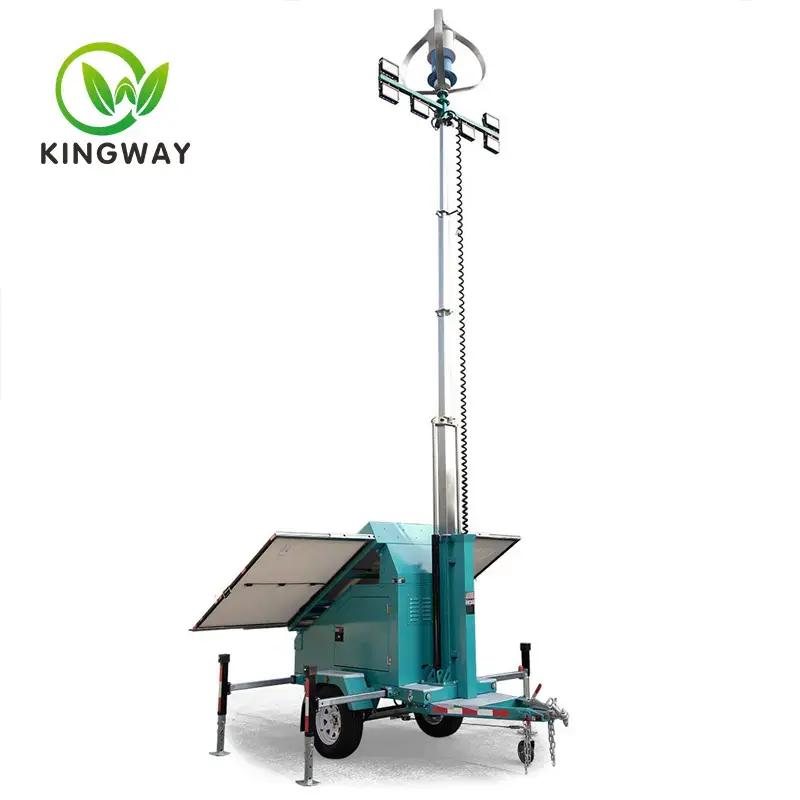
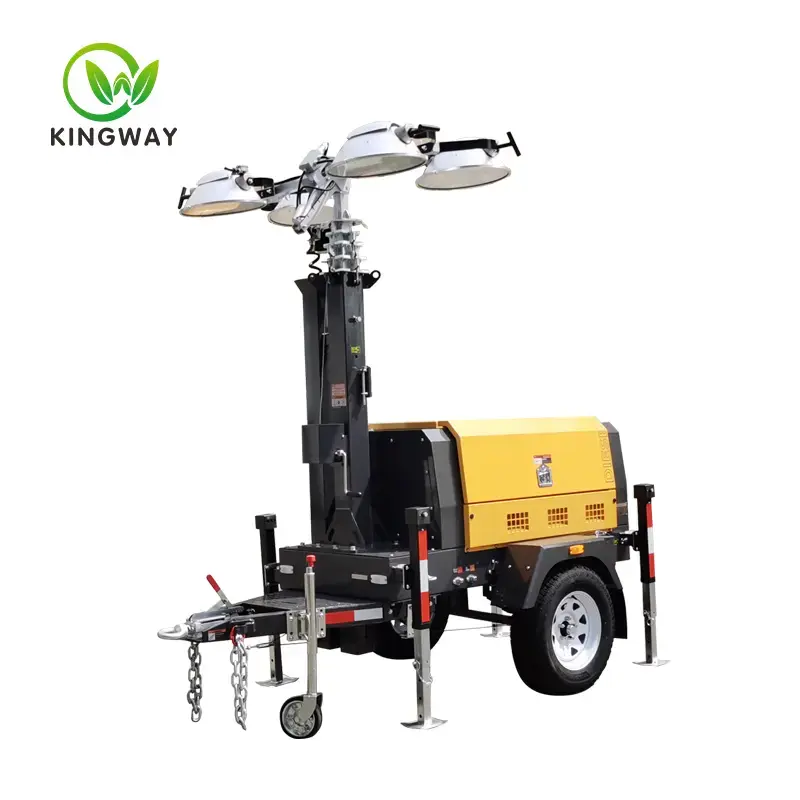
Chassis weight and structure: The chassis is the foundation of wind resistance. A heavy-duty chassis (e.g., a steel chassis) lowers the equipment's center of gravity, reducing the risk of being blown over. A triangular chassis structure is more stable than a rectangular structure and has stronger resistance to crosswinds. Fixing methods: Adjustable ground anchors, counterweights, and anti-slip wheel locks are common fixing devices. Ground anchors are suitable for soft ground, while counterweights are suitable for hardened ground. High-quality products usually come with multiple fixing methods to adapt to different sites.
Pole and bracket strength: The material (aluminum alloy, high-strength steel) and wall thickness of the light pole directly affect wind resistance. Thicker light poles and multi-section reinforced brackets can improve overall rigidity. If the connection between the light pole and the chassis uses welding technology combined with bolt reinforcement, the wind resistance stability will be significantly better than a simple bolt connection.
Light body design: Lightweight and high-strength light body materials (such as aerospace aluminum alloy) can improve structural strength without increasing the load on the chassis. The streamlined design of the light body surface, along with a reasonable installation angle, can reduce wind resistance and prevent direct wind impact from damaging the light body.
5. Wind Resistance Rating Certification Standards and Industry Standards: Avoiding Purchase "Traps"
To avoid purchasing products with "falsely labeled" wind resistance ratings, it is essential to pay attention to authoritative certification standards and industry standards to ensure the accuracy and reliability of parameters:
Domestic Core Standards: Refer to the wind resistance performance requirements for outdoor equipment in standards such as GB/T 30038-2013 LED Lights for Road Lighting and JB/T 10391-2014 Small and Medium-Sized Three-Phase Asynchronous Motors. Qualified products must pass wind tunnel testing by a third-party testing agency and provide a test report.
International Certification References: If the product is targeted at overseas markets or requires higher standards, pay attention to the wind resistance performance testing requirements in CE and UL certifications. These certifications have stricter procedures for wind speed simulation and load testing, effectively ensuring the accuracy of parameters.
Avoid common pitfalls: Some vendors only use vague descriptions like "strong wind resistance" or "suitable for outdoor use" without specific wind speed or rating values. Request a test report. Be wary of "falsely advertised ratings." Compare chassis weight, securing devices, and other configurations to determine if the wind resistance rating is reasonable (e.g., a lightweight chassis labeled as having level 12 wind resistance is likely misleading).
6. Additional wind resistance tips for selection and use: Further enhancing safety
Besides choosing the appropriate wind resistance rating, some details during selection and use can further improve the wind resistance safety of your lighting trailer:
When purchasing: Prioritize brands that support "customized wind resistance configurations." You can add counterweights, reinforced anchors, etc., depending on your specific needs (e.g., typhoon-prone areas). Review user reviews and case studies, focusing on actual usage feedback in similar scenarios, and avoid blindly trusting vendor claims.
Installation and Use: Deployment sites should avoid windy areas such as windy spots and cliff edges; secure the equipment according to the instruction manual. For soft ground, deeply bury and reinforce the ground anchors; for hardened ground, place sufficient counterweights and tighten the wheel locks. During strong wind warnings, promptly lower the light pole height or disassemble and store the light unit to prevent equipment damage.
Daily Maintenance: Regularly check the light pole connections and fixing bolts for looseness and tighten them promptly. After long-term outdoor use, check the ground anchors and counterweights for rust or damage and replace them promptly to ensure wind resistance performance does not decline.
Safety is always paramount in outdoor operations. Choosing a lighting trailer with a wind resistance rating that meets the requirements of the scenario not only ensures smooth operation but also builds a "protective wall" for the safety of construction personnel and equipment. When purchasing, comprehensively judge based on core indicators, scenario requirements, product configuration, and certification standards, and combine this with scientific use and maintenance methods to ensure the lighting trailer functions stably in complex wind conditions.