

Mobile Lighting Trailer Supplier
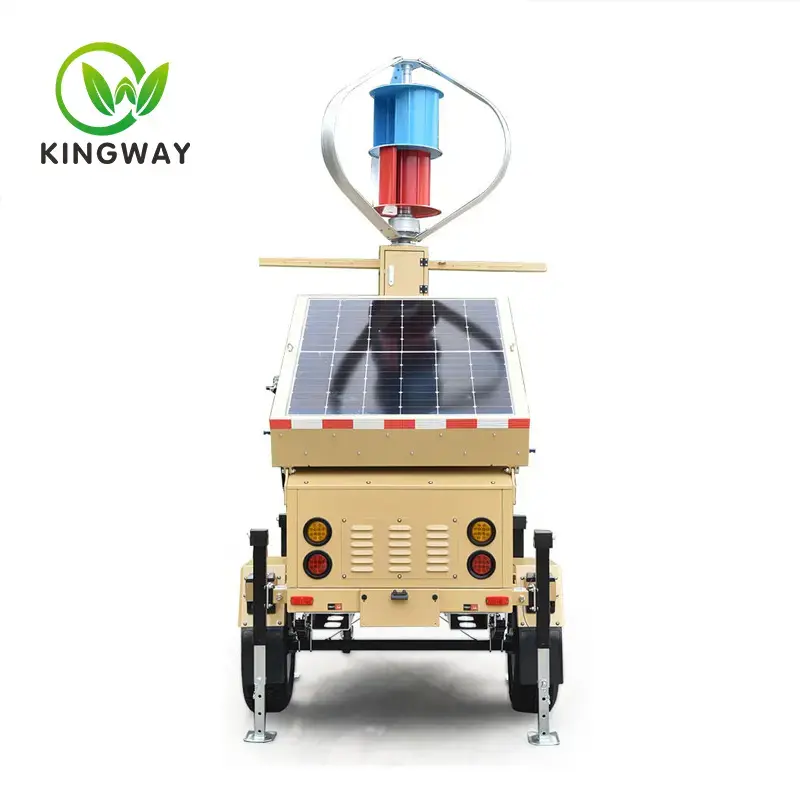
Remote Monitoring and Control Functions of Mobile Lighting Monitoring Trailers
Remote Monitoring and Control Functions of Mobile Lighting Monitoring Trailers: An In-Depth Analysis of the Technical Principles
Mobile lighting monitoring trailers have become indispensable core equipment in modern engineering operations, emergency rescue, and large-scale event security. They not only provide high-intensity, wide-area temporary lighting, but also overcome spatial limitations through remote monitoring and control, allowing workers to monitor on-site dynamics and adjust equipment parameters in real time from the backend, significantly improving operational efficiency and safety. This article will systematically analyze the implementation logic of the remote monitoring and control functions of mobile lighting monitoring trailers from a technical perspective, covering key modules such as hardware architecture, communication links, and software systems. This will help foreign trade clients, project purchasers, and technical practitioners gain a deeper understanding of their technical value.
I. Core Function Overview: The "Dual Capabilities" of Remote Monitoring and Control
Before delving into the technical principles, we must first clarify the core objectives of the remote monitoring functions of mobile lighting monitoring trailers: "visibility" and "accurate control." Remote Monitoring: Real-time video footage, environmental data (such as brightness, temperature, and humidity), and equipment status (such as lighting power, battery charge, and pan/tilt angle) of the trailer site are collected and synchronized to a remote terminal (computer, mobile phone, or tablet), enabling comprehensive visual management.
Remote Control: Remote control sends commands to the trailer via the remote terminal to perform operations such as lighting on/off, brightness adjustment, pan/tilt rotation, camera zoom, and trailer positioning adjustments. It even supports the coordinated dispatch of multiple trailers, enabling precise control from thousands of miles away.
The implementation of these two functions relies on a closed-loop technical architecture consisting of "hardware acquisition - data transmission - software processing - command feedback." Each link must meet the requirements of stability, real-time performance, and security in complex outdoor environments.
II. Remote Monitoring Function: The Technical Link from "On-site Acquisition" to "Back-end Visualization"
The core of remote monitoring lies in "data acquisition and transmission," requiring solutions to the three key issues of "what to collect, how to transmit, and how to display." Its technical principles can be broken down into two modules: a front-end perception layer and a data transmission layer, which work together to achieve "real-time transmission of on-site data." 1. Front-end perception layer: the "hardware foundation" of data collection The front-end perception layer is the "eyes" and "tentacles" of remote monitoring, responsible for converting physical signals (images, light, power, etc.) on site into transmittable digital signals. The core hardware includes the following categories: (1) Video surveillance module: the core of "visibility" The video surveillance module is the core component of remote monitoring and must meet the three major requirements of "high definition, night vision, and wide angle". The common configuration and technical principles are as follows: High-definition camera: The mainstream adopts 2 million to 8 million pixel network cameras (IPC) and supports H.265/H.264 video encoding technology - H.265 encoding can reduce bandwidth usage by 50% compared to H.264 at the same image quality, which is crucial for limited outdoor communication resources; Night vision function: integrated infrared (IR) fill light or laser fill light, automatically switches to night vision mode when the ambient brightness is lower than the threshold (such as 10 lux). The infrared fill light can illuminate at a distance of 30-100 meters, while the laser fill light can cover a range of 100-300 meters, ensuring clear nighttime images.
Pan-tilt and zoom: Some high-end models are equipped with an electric pan-tilt (horizontally rotating 360°, vertically rotating - 90° to 90°) and an optical zoom lens (10x-30x zoom). The shooting angle and focal length can be adjusted through remote commands to achieve "magnification of key area details";
Intelligent analysis chip: Some cameras have built-in AI chips that support functions such as motion detection, face recognition, and cross-border alarms. When abnormal movements are detected (such as strangers breaking in), an alarm can be automatically triggered and a screenshot can be pushed to the remote terminal, reducing the pressure of manual monitoring.
(2) Environment and device status acquisition module: Supplement to "perception details"
In addition to video images, remote monitoring also requires real-time understanding of the environment and the device's own status to avoid downtime due to harsh environment or equipment failure. Core data acquisition components include:
Brightness sensor: Using a photoresistor or digital light sensor (such as the BH1750), it collects real-time ambient light intensity (in lux). This data is used to automatically adjust lighting brightness (e.g., reducing power during the day and increasing it at night), achieving a balance between energy conservation and lighting effectiveness.
Temperature and humidity sensor: Such as a DHT11/DHT22, it collects temperature and humidity data inside the trailer (e.g., the battery compartment and control box) and the external environment. When the temperature exceeds 60°C (or falls below -20°C), it triggers a high/low temperature alarm to prevent damage to equipment components.
Battery and power monitoring module: Using current and voltage sensors, it collects real-time data such as battery charge (SOC), lamp operating power, and charging status. When the battery level drops below 20%, it sends a "low battery alert" to prevent the trailer from shutting down due to power outages.
GPS/Beidou positioning module: Integrated dual-mode positioning chip (supporting GPS and Beidou), with positioning accuracy of 1-5 Meters, real-time trailer location information is transmitted back, facilitating remote scheduling (for example, when multiple trailers are distributed across a large construction site, the locations of each device can be visually viewed on a map).
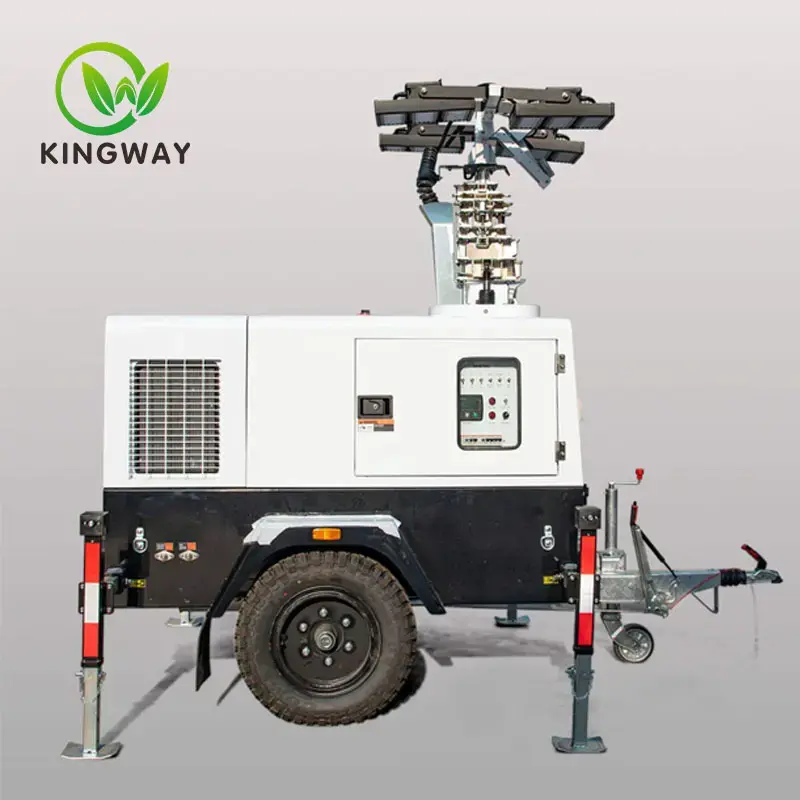
2. Data Transmission Layer: "Opening" the Communication Link Between the Site and the Backend
Video data and sensor data collected by the frontend must be transmitted to the remote backend via a stable communication link. This is the "lifeline" of remote monitoring. Considering that mobile lighting monitoring trailers are mostly used outdoors (such as remote construction sites and emergency sites), the communication solution needs to take into account both "coverage" and "transmission rate". The mainstream technologies include the following three categories: (1) Cellular communication (4G/5G): mainstream general solution 4G/5G communication is currently the most commonly used transmission method and is suitable for scenarios with mobile phone signal coverage. The technical advantages are significant: Transmission rate: The downlink rate of 4G network can reach 100Mbps-1Gbps, which is enough to support 1-4 channels of HD video (each HD video requires a bandwidth of about 4-8Mbps); 5G network supports higher concurrency (can transmit 8-16 channels of HD video at the same time) and the delay is as low as 10-20ms, achieving "near real-time images"; Coverage: Relying on operator base stations, the coverage range is wide (can be used except in extreme areas such as deserts and deep mountains), no need to build a communication network, and low deployment cost; Stability optimization: Some trailers are equipped with dual SIM cards SIM card (supports different operators). When the signal of one operator is weak, it automatically switches to another card to avoid communication interruption. It also supports the "traffic control" function, which can set a monthly traffic limit to reduce the communication costs of foreign trade customers. (2) Satellite communication: "Backup plan" for extreme environments In remote scenes without mobile phone signals (such as desert exploration and offshore operations), satellite communication becomes the only choice. Its technical principles and application characteristics are as follows: Working method: The trailer is equipped with a small satellite terminal (such as a VSAT satellite station) to send data to a synchronous satellite through an antenna, which is then forwarded to the ground gateway and finally connected to the Internet. Advantages and limitations: The coverage range is wide (can be used worldwide), but the transmission rate is low (generally 1-10Mbps), only supports 1-2 channels of standard-definition video, and the communication cost is high (satellite traffic costs are much higher than cellular networks). Therefore, it is usually used as a "backup communication plan" to complement 4G/5G. (3) Short-range wireless communication (WiFi/Bluetooth): Short-range debugging assistance WiFi and Bluetooth are mainly used for "short-range local debugging" rather than remote transmission: WiFi: The trailer can be used as a WiFi hotspot. Workers can connect to the hotspot within a range of 100 meters (unobstructed) to directly view the camera image or adjust device parameters. It is suitable for on-site temporary debugging; Bluetooth: The transmission distance is short (10-30 meters). It is mainly used for "local pairing" (such as connecting to a mobile phone APP to initialize the device) or transmitting a small amount of sensor data (such as temperature, humidity, and power). 3. Remote control function: closed-loop logic from "background instructions" to "on-site execution" The core of remote control is "instruction issuance and execution", which must ensure "accurate instructions, timely response, and safe operation". Its technical principles involve the instruction sending layer, instruction execution layer, and security verification layer. The three together constitute a closed loop of "issuance-execution-feedback". 1. Command sending layer: "operation entry" of remote terminal Remote control commands need to be sent through terminal devices (computers, mobile phones, tablets). The core carrier is the "software platform", which is divided into two categories: Web platform and mobile APP: (1) Web platform: suitable for centralized management on PC side The Web platform is deployed on the cloud server (or the customer's own server), supports multiple account login and multiple device management. The core functions include: Device list and map positioning: All connected trailer equipment are displayed on the left side of the page, and the location of each device is intuitively marked on the map on the right. Click on the device to view real-time video and status data; Control panel: Provides visual operation buttons, such as "light switch", "brightness adjustment (0%-100% slider)", "pan-tilt rotation (direction keys)", "camera zoom (+/-)", and the command is issued in real time after clicking; Scheduled tasks and scene mode: Support setting timed commands (such as "automatically turn on the lights at 18:00 every day and turn off at 6:00 the next day"), or customize "scene mode" (such as "Emergency Mode": Lighting power is set to 100% and cameras are enabled for motion detection; "Energy Saving Mode": Lighting power is set to 50% and non-essential sensors are disabled.
Data Reports and Logs: Automatically record data such as equipment operating hours, power consumption, and alarm history, generating daily, weekly, and monthly reports to facilitate cost accounting and equipment maintenance for foreign trade customers. (2) Mobile APP: Suitable for anytime, anywhere control. The mobile APP (supports iOS and Android systems) is a supplement to the web platform, meeting the needs of "mobile office". Its core advantages are: Lightweight operation: The interface is simple, retaining only core control functions (such as light switch, pan/tilt adjustment), and the operation steps are no more than 3 steps, suitable for quick operation by on-site staff; Push notification: When the device triggers an alarm (such as low battery, high temperature, abnormal intrusion), the APP pushes a notification (sound + pop-up window) in real time, and the staff can immediately view the alarm details and handle it remotely; Offline cache: Supports caching of the last 1 hour of video footage. When the network signal is weak, historical footage can still be viewed to avoid data loss. 2. Command Execution Layer: "Action Response" of On-site Devices
Remotely issued commands must be converted into physical actions by the trailer's internal "control unit." The core hardware consists of an embedded controller (ECU) and actuators. The workflow is as follows:
Command Receiving: The ECU receives remote commands (e.g., "Adjust the light brightness to 80%)" via a communication module (4G/5G/satellite) and parses the command (confirming the correct format and device ID).
Logical Decision Making: The ECU makes a decision based on the current device status. For example, if the command is "Turn on the light," but the battery level is below 10%, the ECU will reject the command and return a "low battery, cannot turn on" response.
Actuator Driving: If the command is valid, the ECU sends a control signal to the corresponding actuator.
Light Control: PWM (Pulse Width Modulation) signals are used to adjust the output voltage of the light driver power supply, enabling stepless brightness adjustment from 0% to 100%.
Pan/Tilt Control: Sends forward and reverse signals (e.g., "Pan/Tilt + Turn") to the pan/tilt motor. 30°”), the motor drives the gimbal, while the encoder provides real-time feedback on the current angle to ensure rotation accuracy.
Charging Control: If the command is "Start Charging" (when connected to AC power or solar panels), the ECU controls the charging module to start and monitors the charging current to prevent overcharging.
Status Feedback: After the actuator completes its action, the ECU transmits the "execution result" (e.g., "Light brightness has been adjusted to 80%" or "Gimbal has rotated to the specified angle") to the remote terminal, forming a closed loop of "command issuance - execution - feedback," ensuring that personnel know whether the operation was successful.
3. Security Verification Layer: Technical Guarantee to Prevent "Illegal Manipulation"
Remote control involves device operation permissions and data security, requiring multiple security mechanisms to prevent unauthorized intrusion. Core technologies include:
Account Permission Hierarchy: Different account levels are set (e.g., "Administrator": can control all devices and modify parameters; "Operator": can only control specific devices and view data; "Guest": can only view data, no control permissions) to prevent abuse of permissions;
Data Encryption Transmission: All data (video, commands, sensor data) is encrypted using the HTTPS/TLS 1.3 protocol to prevent data theft or tampering during transmission;
Device Unique Identification (ID): Each trailer is equipped with a unique hardware ID and key. Remote commands must carry this ID and key for the ECU to recognize them, preventing commands from being sent to the wrong device;
Abnormal Behavior Detection: If the same IP address continuously sends incorrect commands (such as incorrect IDs or illegal commands) within 10 minutes, the system will automatically block the IP address to prevent brute force attacks.
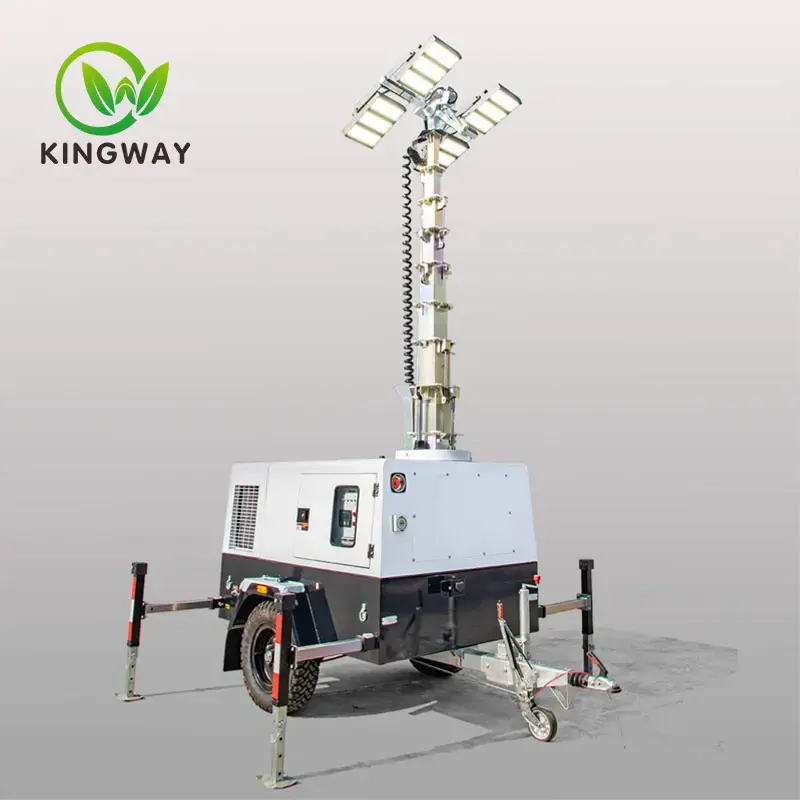
IV. Technical Difficulties and Solutions: "Hardcore Design" for Complex Outdoor Environments
Mobile lighting monitoring trailers often operate in harsh outdoor environments (high and low temperatures, heavy rain, dust, and vibration), posing numerous challenges to the stability of remote functions. The following are the core technical challenges and corresponding solutions:
1. Communication Stability: Addressing "Signal Fluctuations"
Difficulty: In outdoor scenarios, 4G/5G signals may fluctuate due to obstructions (such as tall buildings and mountains) and long distances from base stations, resulting in data interruptions or delays.
Solution:
Multi-mode communication redundancy: 4G/5G and satellite communication modules are integrated simultaneously. When the 4G/5G signal strength drops below -90dBm, it automatically switches to satellite communication (or WiFi in close-range scenarios).
High-gain antenna: The communication antenna features an omnidirectional, high-gain design (gain of 8-12dBi) and is mounted in an unobstructed position on the trailer's roof to enhance signal reception.
Data caching and retransmission: The front-end sensing layer uses a local SD card (64GB-256GB capacity). When communication is interrupted, video and sensor data are temporarily stored on the SD card and automatically retransmitted to the backend upon restoration, preventing data loss.
2. Power supply stability: Addressing the risk of power outages
Difficulty: The trailer relies on batteries (or solar panels) for power. If the battery is depleted or the solar power is insufficient, remote functions will fail.
Solution:
Dual power supply system: Equipped with a main battery (lithium battery, capacity 100Ah-500Ah) + a backup battery (lead-acid battery, capacity 50Ah-100Ah). Automatically switches to the backup battery when the main battery is depleted, ensuring at least four hours of remote operation.
Solar charging: A solar panel (100W-300W) installed on the trailer roof charges the battery during the day, extending battery life (allowing for "operating while charging" on sunny days).
Low-power mode: When the battery charge falls below 20%, the system automatically enters low-power mode. This mode disables some HD cameras (retaining one channel of standard-definition video), reduces sensor sampling frequency, and disables non-essential communication modules, retaining only core monitoring and control functions, extending battery life to over eight hours.
3. Equipment Protection: Coping with Harsh Environments
Difficulties: High and low temperatures, heavy rain, and dust can damage hardware and affect the stability of remote functions (e.g., water ingress to the camera lens causes blurry images, or the ECU freezes due to high temperatures). Solution:
Protection-grade design: The core hardware (camera, control box, and battery compartment) is IP67/IP68 rated. IP67 protects against short-term immersion (1 meter depth for 30 minutes), and IP68 protects against long-term immersion (2 meters depth for 1 hour). The housing is constructed of corrosion-resistant aluminum alloy to prevent intrusion of dust and rain.
Temperature and humidity control: The control box integrates a cooling fan and heater. When the temperature exceeds 50°C, the fan activates to dissipate heat, and when it falls below -10°C, the heater activates to increase the temperature, ensuring a stable operating temperature of the ECU between -20°C and 60°C.
Vibration-resistant design: The camera, sensor, and other components are secured with shock-absorbing rubber brackets that absorb over 60% of vibration energy (such as the bumps of a moving trailer), preventing component loosening and damage.
V. Application Scenarios and Technical Value: Why Remote Control Is a Must-Have for Foreign Trade Customers
Now that we understand the technical principles, we need to further clarify: What practical value does remote monitoring and control bring to foreign trade customers? The following are three core application scenarios and their corresponding value propositions:
1. Engineering Operations (e.g., road construction, construction sites)
Value 1: Reduced Labor Costs: Traditional trailers require dedicated personnel on-site to perform tasks like turning lights on and off, adjusting cameras, etc. The remote function allows one person to manage over 10 devices, significantly reducing labor costs.
Value 2: Improved Safety Management: Remote video allows real-time monitoring of construction sites for violations (e.g., not wearing a hard hat, unauthorized entry at night), and immediate remote alarms when any anomalies are detected, reducing the risk of safety incidents.
Value 3: Optimized Equipment Scheduling: When multiple trailers are deployed in different construction areas, the location and battery level of each device can be viewed on a backend map, prioritizing equipment with sufficient battery life to avoid idle or insufficient equipment. 2. Emergency Rescue Scenarios (e.g., earthquakes, floods, fires)
Value 1: Rapid Deployment: Even in hazardous environments, workers can remotely activate lights and adjust cameras without having to approach the trailer, quickly establishing a temporary monitoring and lighting system.
Value 2: Real-Time Command: Remote video monitoring allows the backend to monitor the rescue scene (e.g., the location of trapped personnel and the direction of fire spread) and utilize GPS positioning to dispatch rescue vehicles, improving command efficiency.
Value 3: Data Retention: The remote system automatically records video and environmental data during the rescue process, which can be used for subsequent rescue plan review and optimization.
3. Large-Scale Events (e.g., concerts, sporting events)
Value 1: Dynamic Lighting Adjustment: Remotely adjust lighting brightness and angles in real time based on the event flow (e.g., opening, intermission, closing) to meet the lighting needs of different scenarios.
Value 2: Security Collaboration: Cameras on multiple trailers form a "surveillance network," enabling real-time monitoring of areas like the auditorium and aisles through switching between different screens. Security personnel can be immediately dispatched if crowding or conflicts are detected.
Value 3: Energy Saving and Consumption Reduction: Automatically adjust power based on brightness sensor data, avoiding energy waste from "lighting on during the day" and reducing event operating costs.
VI. Future Technology Trends: Upgrading the Remote Functionality of Mobile Lighting Monitoring Trailers
With the development of the Internet of Things (IoT), artificial intelligence (AI), and 5G technologies, the remote functionality of mobile lighting monitoring trailers will be upgraded to become more intelligent, collaborative, and environmentally friendly. The following are three trends worth noting for foreign trade customers:
1. Deep Integration of AI: From "Passive Monitoring" to "Active Warning"
Future remote monitoring will no longer be simply viewing images; instead, AI algorithms will enable intelligent analysis and proactive warnings.
For example, cameras can automatically identify individuals without helmets and illegally parked vehicles, triggering alarms without manual inspection.
Lighting fixtures can use AI to learn user habits (e.g., a construction site requires high brightness lighting from 7:00 PM to 10:00 PM daily) and automatically optimize brightness adjustment strategies, further saving energy.
Equipment Failure Prediction: AI analyzes sensor data (such as battery charge count and motor operating noise) to predict potential failures (e.g., "battery will fail in one month") and send maintenance reminders to avoid unplanned downtime. 2. Internet of Things (IoT) Collaboration: Interconnectivity among Multiple Devices
In the future, mobile lighting monitoring trailers will become "nodes in the IoT network," collaborating with other devices (such as drones, sprinkler trucks, and access control systems).
For example, if a patrol drone discovers a fire hazard in a certain area of a construction site, it can automatically send a command to a nearby mobile lighting monitoring trailer to turn on the lights (facilitating firefighting) and activate the camera (to record the fire).
The trailer will be linked to the access control system: When an authorized person enters the construction site through the access control system, the trailer will automatically turn on the lights in the corresponding area and turn them off when the person leaves.
3. Green Energy and Low Carbon: Reducing Lifecycle Costs
With the global trend toward carbon neutrality, remote functions will be deeply integrated with green energy:
Using higher-efficiency solar panels (with conversion efficiency increased to over 30%) and energy storage batteries (such as lithium iron phosphate batteries with a cycle life of over 3,000 cycles), this will extend trailer driving time and reduce reliance on utility power.
The remote system will also include an "energy consumption analysis" function that automatically calculates the carbon emissions of each device and provides energy-saving recommendations (e.g., "Adjusting light brightness can reduce carbon emissions by 10%)," helping foreign trade customers achieve their low-carbon operation goals.